
Under Arizona product liability law, a failure to warn is a distinct cause of action alongside other causes of action, such as negligence and strict liability. It is also called a “marketing defect” or an “informational defect.”
Unlike a design or manufacturing defect claim, in a failure-to-warn claim, the product may not be defective in its design or manufacture; it may be working exactly as the manufacturer intended. The liability is based on the product being unreasonably hazardous to consumers because its manufacturer failed to provide adequate safety warnings or instructions.
In this blog post, we focus on failure to warn Arizona product liability claims, including examples of how they can arise, the elements you need to prove to make a legal claim, possible manufacturer defenses you may encounter, and what you can do in the immediate aftermath of being injured by a defective product.
Although product liability claims are based on general principles of Arizona personal injury law, they have some unique proof requirements that require your personal injury lawyer to have specific knowledge and experience in making them. This is the kind of legal representation you will have when you hire Stone Rose Law.
To speak with one of our Arizona personal injury legal professionals, call us at any time at (480) 631-3025, or you can contact us online to schedule a free initial case evaluation.
What is Arizona’s Failure to Warn Law for Product Liability?
You can find Arizona’s product liability laws in Article 9 of Title 12 of Arizona’s Revised Statutes (ARS). The 10 specific sections are ARS 12-681 through ARS 12-690.
Failure to warn claims fall within Arizona’s definition of a ‘product liability action’ under ARS 12‑681(5), which includes injuries caused by inadequate warnings or instructions, including:
- The failure to warn or protect against a danger or hazard in the use or misuse of a product; or
- The failure to provide proper instructions for the use or consumption of any product.
Arizona cases interpreting this law have held that inadequate instructions or warnings make a product defective when proper instructions or warnings could have prevented the harm. The failure to warn extends to a product’s intended use and to harm from the reasonably foreseeable misuse of a product.
Failure to Warn Examples in Product Liability
Several historical examples exist of products that manufacturers knew or should have known could cause harm but failed to provide adequate instructions or warnings. Some of the more well-known failure to warn lawsuits include:
- Johns‑Manville asbestos: This is possibly the most famous example of failure to warn litigation, because the company knew for decades that asbestos was deadly, yet continued selling asbestos‑containing insulation, construction materials, and industrial products without adequate warnings.
- Johnson & Johnson talcum powder: Thousands of women sued Johnson & Johnson, alleging its talc-based powders failed to warn about the risk of ovarian cancer and other illnesses.
- Monsanto/Bayer Roundup® weed killer: Users of Roundup herbicide developed cancers like non-Hodgkin’s lymphoma, and claimed the manufacturer failed to warn about the carcinogenic risk.
- Prescription drug cases: Many drug injury lawsuits center on inadequate warning labels that fail to inform of potentially dangerous side effects. In Arizona, under the learned intermediary doctrine, the manufacturer’s duty is usually to warn the doctor, who should then warn the patient.
- Common household products: Household cleaners or appliances can cause severe respiratory injury if used without ventilation, and consumers are given no warning about ventilation or protective gear on the label. Other common scenarios include children’s products that lack warnings about choking hazards or appliances that lack hot-surface warnings.
Elements of a Failure to Warn Claim in Arizona
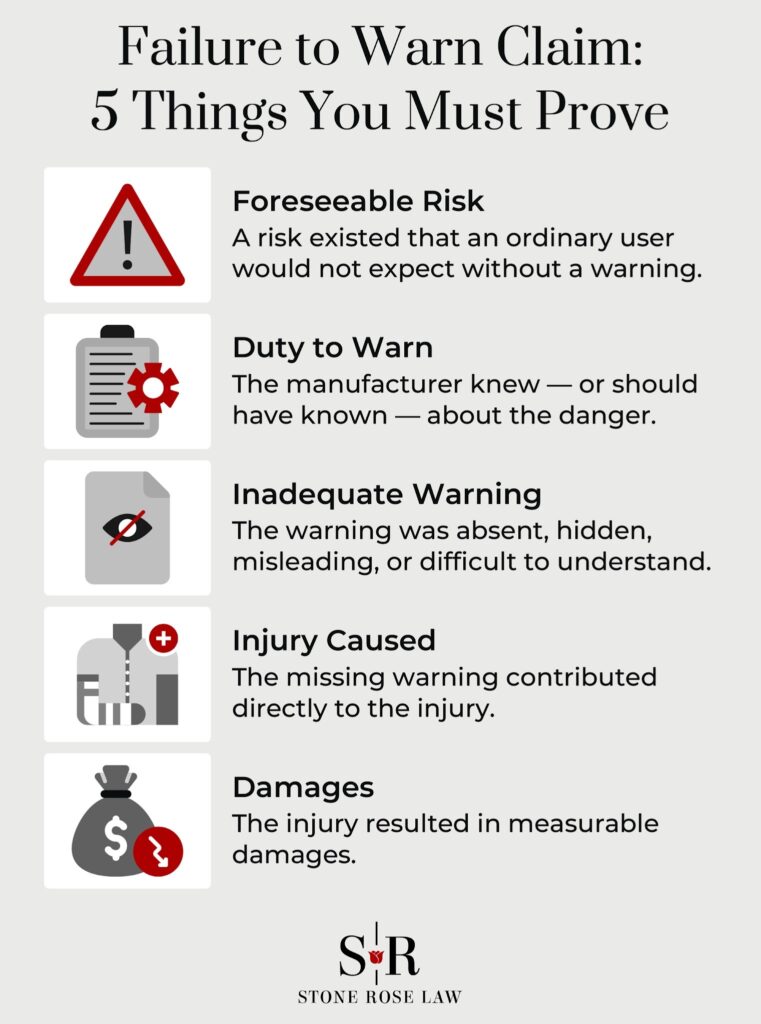
To win a failure-to-warn claim in Arizona, you generally need to prove all of the following elements.
The Product Had a Foreseeable Risk
A hazard existed with the product’s use that was the kind of risk an ordinary user would not expect without warning.
The risk could be from normal use or a common misuse that the manufacturer should anticipate.
Duty to Warn
The manufacturer knew, or should have known, about the risk. This gives rise to the manufacturer’s duty to provide a warning or clear instructions about that risk.
Inadequate or Missing Warnings
The manufacturer breached its duty to warn by failing to provide a warning or by giving an insufficient warning about the product’s hazards.
The warning may have been completely omitted, or it existed but was insufficient because of unclear language, or it was hidden in fine print, or it misleadingly downplayed the danger.
Causation
The lack of adequate warning must have proximately caused your injury. You must show you were hurt specifically because the required safety information was missing.
Actual Injury and Damages
The harm you suffered from inadequate warnings or instructions must have led you to experience real harm, like physical injuries or an illness, that can be measured in monetary damages.
The harm can be broken down into economic damages, such as medical bills, lost wages, and lost future earning capacity, and non-economic damages, which compensate for intangible harms like pain and suffering, mental anguish, or loss of companionship or consortium.
In a few cases, a failure to warn can lead to punitive damages.
A classic punitive damages example was Bullock v. Philip Morris, a California lawsuit brought by an individual smoker that led to a jury award of $28 billion in punitive damages, later reduced to $28 million, because the company knew for decades that cigarette smoking was addictive and caused cancer, yet failed to warn users of its product of these risks.
The table below summarizes the elements of a failure to warn claim and the kinds of evidence you can use to prove each element.
| Element of Claim | Types of Evidence to Prove It |
|---|---|
|
Foreseeable Risk of Harm |
Documentation of known hazards, like internal reports or safety studies, prior accident reports, consumer complaints, or industry research on the product’s risks. |
| Manufacturer’s Duty to Warn | Evidence that the risk was known or knowable: internal emails, warnings on similar products, scientific data available at the time, or expert testimony showing the danger was foreseeable. |
| Inadequate or Missing Warnings or Instructions | The product and its packaging or instructions; comparisons to standard warnings in the industry; photos of labels; expert analysis of warning adequacy, like font size, wording, and placement. |
| Causation | Your account of how you used the product, showing that you had no warning of the risk; expert testimony that a reasonable user would have heeded a proper warning; evidence that no other causes explain the injury. |
| Damages | Medical records of your injury; doctor’s reports linking your injury to product exposure; hospital bills, receipts; proof of lost work days or income; and any ongoing treatment needs. |
What Legal Defenses Might You Encounter with a Failure to Warn Claim?
Manufacturers may raise several defenses to failure-to-warn-based product liability claims. What follows are some of the most common defenses:
- Obviousness of the risk: This defense is that no warning was required because the danger would be reasonably apparent to any ordinary user of the product, even in the absence of warnings or instructions (for example, a knife does not require a warning that it is sharp and can cut the user).
- A misuse of the product was unforeseeable: A manufacturer is not required to warn against an unpredictable misuse of its product that it could not reasonably foresee, or the product was used outside of its intended purpose.
- The warnings or instructions provided were, in fact, adequate: This defense effectively claims that the warnings or instructions were clear, visible, and comprehensible, but you ignored them. ARS 12-683(3) provides a defense if your injury was caused by the use of the product contrary to clear warnings or unforeseeable misuse.
- Actual knowledge of the risk by the user: This claim argues that you knew of the risk, but effectively either assumed it or that your recovery of damages can be reduced under the Arizona comparative fault theory.
- The risk was unknown or unknowable by the manufacturer at the time of the injury: A manufacturer’s duty to warn extends only to risks of harm that it knew, or should have known about. If the risk was scientifically unknowable at the time of the product’s sale, then no duty to warn could have existed.
- Federal preemption of a state law product liability claim: This is a possibility in failure-to-warn claims involving medical devices and in pharmaceutical labeling claims.
- You cannot prove the failure to warn caused your harm: Even if the manufacturer had provided a warning or instructions, this would not have changed your behavior when using the product, or something else caused your injury.
In addition, Arizona’s product liability laws provide some specific potential defenses in limited situations, including:
- The “state-of-the-art” defense: ARS 12-683(1) offers the manufacturer a defense if the design, testing, or labeling of its product met the scientific safety standards of the time.
- ARS 12‑551 imposes a 12‑year statute of repose on strict‑liability product claims, but it does not apply to negligence or express‑warranty claims, and courts have limited its application in certain latent‑injury contexts.
What Can You Do if You Were Injured Because of a Failure to Warn?
If you have been injured because of a product’s lack of instructions or warnings, here are some practical steps to take to strengthen your possible legal claims against the manufacturer and seller of the product.
- Seek medical attention right away. Get immediate medical care for your injuries. Follow your doctor’s recommendations, and keep all medical records; these can document the harm you have suffered and link it to your exposure to the product. Take photos of your injuries.
- Preserve the product if possible. Save the product in question, along with its packaging, instruction manuals, labels, and receipts. These items are critical evidence in a failure-to-warn claim.
- Do not alter or repair the product. Store the product safely, and take photos of it, especially if any existing warnings are on it.
- Document what happened. As soon as possible, write down a detailed account of how you used the product and what happened. Note if there was no warning, or an inadequate warning, about the hazard that injured you. If others witnessed the incident, get their names and statements.
- Avoid giving statements to the manufacturer or its insurance company. If a manufacturer’s representative or insurance adjuster contacts you, do not give any recorded statements, sign any papers, or accept any settlement before getting legal advice.
- Consult an Arizona product liability attorney. An experienced product liability lawyer will be able to assess if you have a valid failure to warn case and help preserve your rights.
Do You Have a Failure to Warn Product Liability Case in Arizona?
A manufacturer’s failure to provide adequate safety instructions and risk warnings with its products can make it liable to you under Arizona products liability law. Still, you will need to carefully prepare your claim in advance to maximize your chances of a favorable outcome.
Like most personal injury claims, product liability failure-to-warn claims often settle out of court. The degree of seriousness with which a manufacturer or its insurer will treat you in settlement negotiations will depend greatly on how strong your evidence is and how thoroughly your product liability attorney prepares your claim for the possibility of going to trial.
This is why it is important to have an experienced and skilled Arizona product liability law firm, like Stone Rose Law, on your side from the beginning.
Our attorneys will carefully investigate the facts of your product-related injury or illness to determine whether the manufacturer knew of the risk, gather expert opinions on the missing warnings, and ensure your claim is filed on time under Arizona’s product liability statute of limitations.
We will also advise you on possible additional steps, such as reporting your injury to federal regulators like the Consumer Product Safety Commission or the Food and Drug Administration, if applicable, and checking whether any existing recall or class-action related to the product has already been filed.
The experience and expertise of your legal counsel can have a strong impact on the value of your settlement claim and your chances of receiving fair compensation from a judgment award if settlement is not possible.
To speak with a Stone Rose Law product liability attorney and schedule a free consultation with our failure-to-warn attorneys, call our law offices at (480) 631-3025 or use our online contact form.

The post Failure to Warn Product Liability Cases appeared first on Stone Rose Law.