

Unfortunately, fatal collisions occur every day across the United States. Most commonly, fatal crashes occur when two or more vehicles collide. But outside of other vehicles, what are drivers most likely to hit in fatal crashes? Poles? Trees? Curbs? Or something else? We examined 20 years of fatal crash data from the National Highway Traffic Safety Administration (NHTSA) to find out.
A fatal crash can involve multiple factors or events, however. Therefore, this analysis focuses on the “most harmful event” for each crash. According to the NHTSA, the most harmful event is defined as “the event that resulted in the most severe injury or, if no injury, the greatest property damage involving this vehicle.”
Between 2000-2019, there were 692,276 fatal motor vehicle crashes in the United States – with over 60 percent involving moving vehicles, pedestrians, and rollover/overturns.
Part one of this analysis examines the most common sources of fatal crashes, while part two examines the less frequent ones.
Which Are the Most Common Types of Fatal Car Crashes?
As previously mentioned, the three most harmful events involve a moving vehicle crashing into another (38 percent), followed by crashes with pedestrians (13 percent) and rollover/overturns (10 percent).
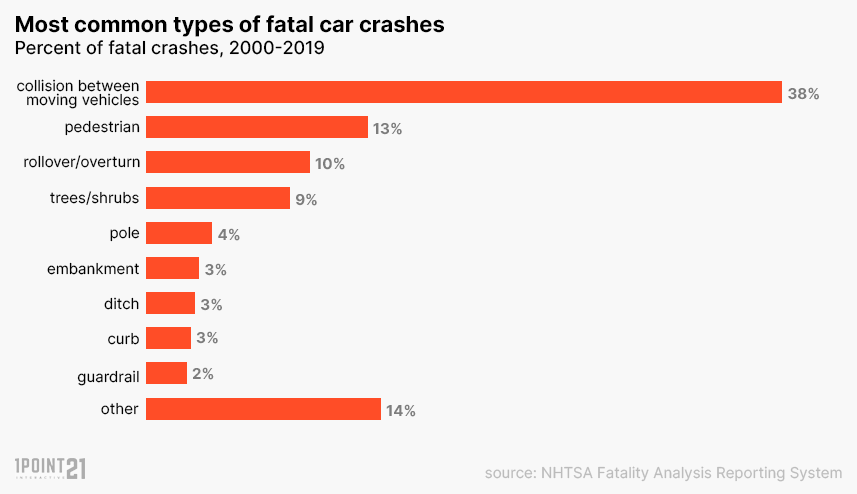
The likelihood of a fatal crash involving a rollover/overturn is nearly the same as that of trees/shrubs (10 percent and 9 percent, respectively).
What Are the Most Common Types of Fatal Crashes by County?

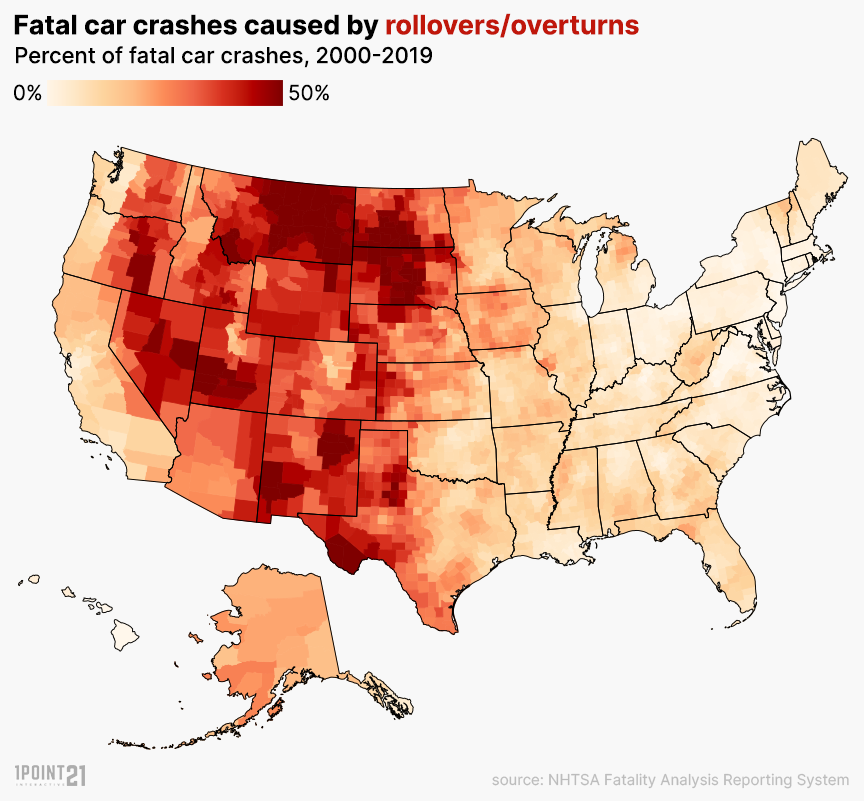
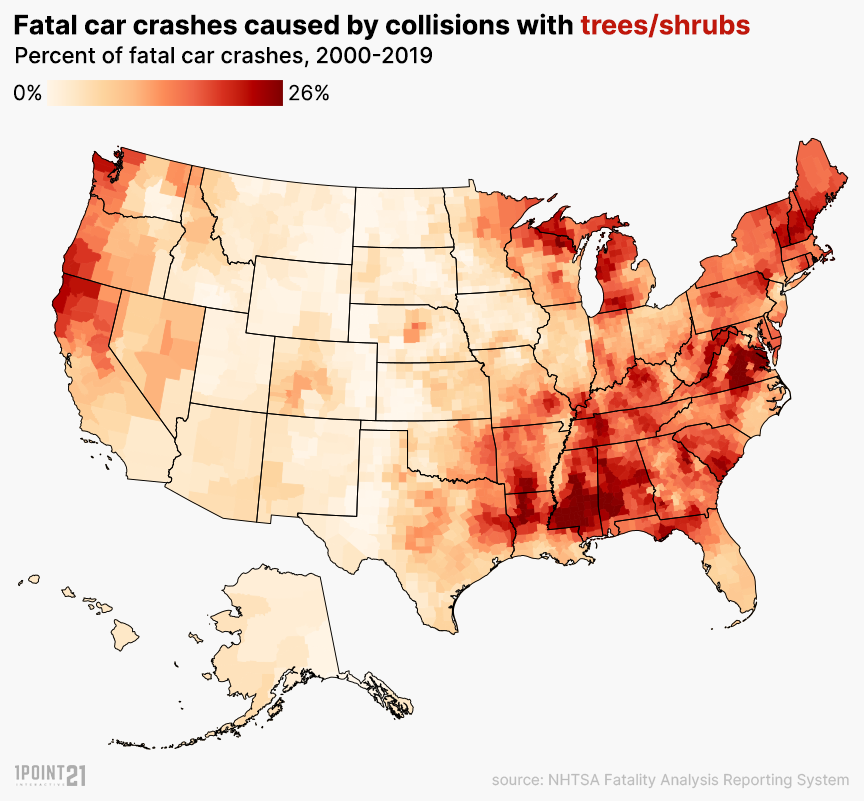
When we look at the map, we see that the most harmful event significantly varies by region. Fatal crashes involving trees or shrubs seem to aggregate in the southeastern and northeastern states, while those with rollover/overturns are clustered more in the western states.
Fatal Crashes With Pedestrians
After collisions with moving vehicles, the second most common fatal crash type involves pedestrians. Pedestrian collisions seem to aggregate in population centers across the U.S. along with large areas of Florida and southern California – states with generally warmer climates and higher populations of pedestrians on the road. They are also common in New Mexico, which has been found to be one of the deadliest states for pedestrians. In Alaska, pedestrians are overrepresented in roadway fatalities, despite making up a small portion of the U.S. total.

Fatal Crashes With Rollover/Overturns
10 percent of fatal crashes involved rollover/overturns. Rollover/overturns occur when a vehicle tips over to its side or roof and are among the most dangerous types of crashes. While any vehicle can roll over, those with a higher center of gravity – such as pickup trucks – are more susceptible to it.
Fatal crashes with rollover/overturns are overwhelmingly located in the western and southwestern regions – where there are significantly more pickup trucks. Wyoming, for example, has 2.4 more registered pickups trucks on the road than the average state.
Fatal Crashes With Trees/Shrubs
Nine percent of fatal crashes involve trees or shrubs. Drivers are most likely to be killed after colliding with a tree in more densely wooded areas in the Pacific Northwest, Northeast, East, and South-Eastern regions. In fact, if you were to overlay this map with U.S. tree density data, you would find that it has almost the exact same shape (save for mountainous regions with no roads).
Collisions with trees can be deadly for obvious reasons, they are large, solid, fixed objects. Fallen trees, however, are an underrated danger on the road that can result from hazardous weather. The strong winds of a winter storm, thunderstorm, or hurricane can cause trees to uproot – and faster in the rainy states. Wet soil isn’t able to hold the tree’s roots as solidly as dry soil, making it more likely for trees to topple over.
Fatal Crashes With Poles
Another deadly fixed object, fatal crashes caused by collisions with poles occurred more often in the western states, including Nevado, Colorado, and Wyoming. Contributing factors to pole-related fatal crashes may include speed, lack of visibility (driving at night), and sudden road curves.

Fatal Crashes With Ditches
Ditch-related fatal crashes occurred most often in the southeast, including North Carolina and South Carolina.

Fatal Crashes With Embankments
Fatal crashes with embankments were most common in the northwest and midwestern states such as Idaho, the eastern states, and Alaska.

Data Sources
This study is based on 2000-2019 fatal crash data from the National Highway Traffic Safety Administration (NHTSA). Interested in seeing how often people hit mailboxes or live animals? Follow this link to view part two of our analysis.
If you would like to report or republish our findings, please link to this page to provide a citation for our work.
The post Data Analysis: The Most Harmful Event in Fatal Crashes appeared first on Stone Rose Law.