
In Arizona personal injury cases, loss of consortium is a family member’s claim for the loss of companionship, affection, care, and support caused by a legally recognized loved one’s injury.
If an injury to a loved one has changed your marriage or your relationship with an injured parent or child, speak with a Stone Rose Law Arizona personal injury attorney before you sign a release or allow a legal filing deadline to pass.
One of our experienced personal injury lawyers can evaluate both the injured person’s claim and your potential loss-of-consortium claim, represent you in settlement negotiations, and represent you in court if you need to file a lawsuit in civil court.
To speak with a member of our personal injury legal team, call us at (480) 631-3025 or reach us online to schedule a free consultation.
What is Loss of Consortium?
No Arizona statute creates the right to make a legal claim for loss of consortium. These personal injury-based claims rely on common law precedents.
In contrast to a personal injury claim, in which you file a civil lawsuit for harm that happened to you, a loss of consortium claim is based on harm suffered by an injured victim who has a family relationship with you that is recognized by this judicial remedy. The focus is on what you have lost because your injured close family member can no longer provide emotional and practical support as before.
Examples of lost consortium include loss of companionship, affection, comfort, care, protection, moral support, household contributions, guidance, or marital intimacy.
Who Can File a Claim for Loss of Consortium?
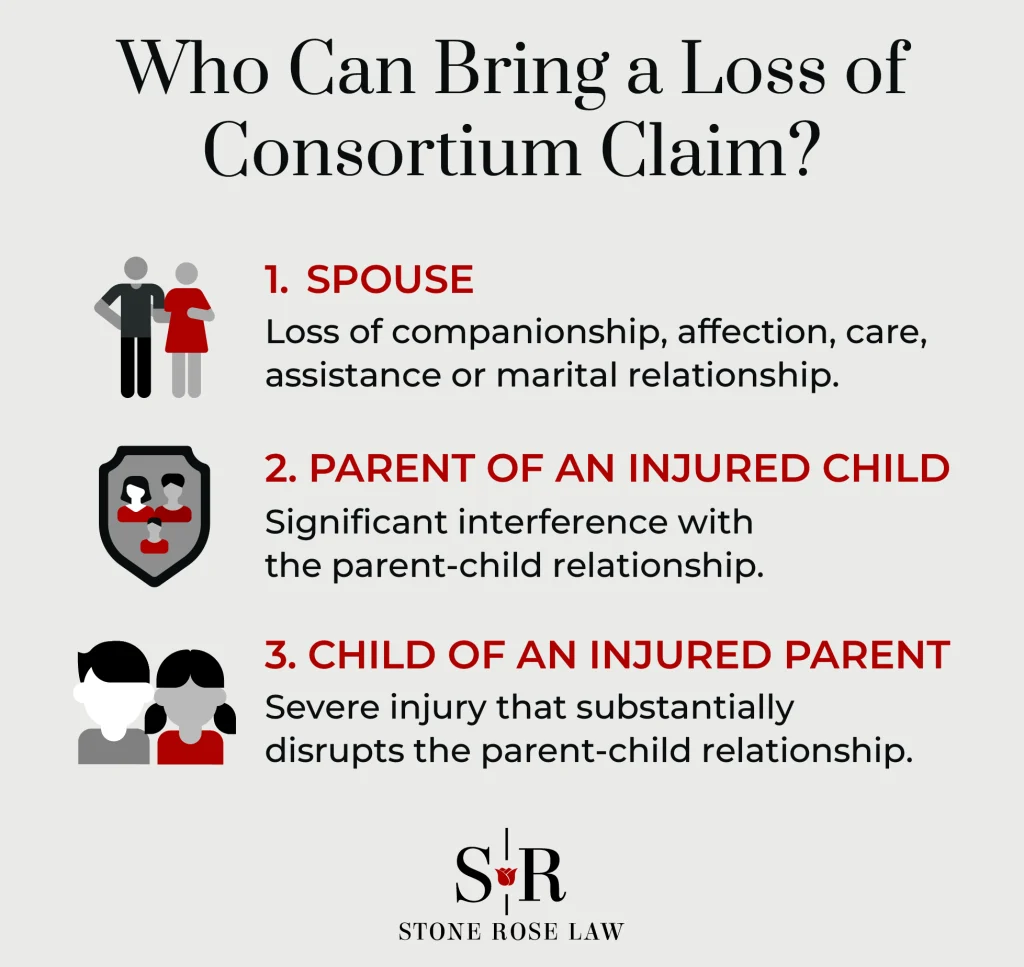
In Arizona, certain family members of an injured person can bring a claim for loss of consortium against the at-fault party. These include the following relatives:
- A husband or wife
- Parents
- Children
A Husband or Wife
Arizona courts have long recognized a spouse’s claim when a personal injury impairs the marital relationship. An uninjured spouse’s claim may encompass diminished companionship, care, affection, assistance, and other marital interests.
The underlying harm to the injured spouse does not have to be physical; a serious psychological or emotional injury may support consortium damages if the marital relationship was actually harmed.
Note that a fiancé or domestic partner may not qualify as a “spouse” under Arizona loss-of-consortium law. A legal marriage must exist.
Parents of an Injured Child
Parents may pursue loss of consortium when their child is seriously injured, whether the child is a minor or an adult.
The qualifying parent must be biological or adoptive. The parent must show much more than the natural fear, grief, or inconvenience that accompanies a child’s injury: the evidence must establish significant interference with the normal parent-child relationship.
Children of an Injured Parent
A claim by minor children for loss of consortium can exist when a third party causes a biological or adoptive parent a serious, permanent, and disabling mental or physical injury that severely damages the parent-child relationship.
Arizona courts apply a very high severity threshold for adult‑child consortium claims, requiring injuries that profoundly disrupt the relationship:
- The parent must suffer a serious, permanent, and disabling injury that severely damages the parent-child relationship. This requires more than grief or emotional distress.
- The adult child must show a meaningful loss of companionship, as well as a loss of a parent’s guidance, affection, or care that existed before the injury.
Limitations on Loss of Consortium Claims
Who can bring a claim for loss of consortium is subject to the following restrictions.
The Claim Must Be Derivative in Nature
A loss of consortium claim is a distinct claim that belongs to the affected family member. But it does not exist independently. Instead, a derivative claim has its origins in and depends on the personal injury claim of the injured person against the same defendant.
So, for example, if a parent is injured but alive, then the adult child may bring a derivative loss‑of‑consortium claim alongside the parent’s injury case.
Joining Loss of Consortium Claims With the Underlying Case
Consortium claims are commonly joined with the injured person’s lawsuit. For a child’s derivative claim, the defendant may require joinder by an appropriate motion; several family members may be plaintiffs in the same case.
Each consortium claimant seeks compensation for their own proven loss of relationship, even when the claims are heard together. This process is different from distributing a wrongful-death recovery among statutory beneficiaries.
Distinguish Wrongful Death From Other Personal Injury Claims
It can be easy to confuse a loss of consortium claim with other, separate claims based in personal injury law. Here are two causes of action that, while they share some surface similarities with loss of consortium, are not the same.
Distinguish Loss of Consortium from Wrongful Death Claims
A loss of consortium claim is based on harm to the relationship caused while the injured person is alive. In contrast, a wrongful-death claim arises from death and exists only under Arizona’s wrongful-death statute, ARS 12-611. A wrongful death claim exists when the deceased person would have had a personal injury cause of action if he or she had not died.
Under ARS 12-612, a wrongful death action may be brought by a surviving spouse, child, parent, or guardian, or by the personal representative of the fatally injured person’s estate on behalf of these statutory beneficiaries. Any recovery is distributed among the eligible beneficiaries in proportion to their damages.
- An Arizona wrongful-death action has one statutory plaintiff and one judgment, with each beneficiary proving an individual loss under that action. Consortium claims, by contrast, belong to the individual family members asserting them.
- Also, as with loss of consortium, under ARS 12-613, wrongful death damages may include lost companionship, care, protection, and guidance, but these are rolled into the wrongful death recovery rather than being based on a derivative loss-of-consortium claim.
Distinguish Loss of Consortium from Emotional Distress
Emotional distress is a type of non-economic damages remedy available in a personal injury claim for emotional and relational harm. Examples of emotional distress include worry, grief, or distress after learning that a family member was hurt. But emotional distress is not the same as loss of consortium, which is based on the loss of the capacity to exchange love, affection, society, companionship, comfort, care, and moral support.
How Do I Make a Legal Claim for Loss of Consortium?
Loss of consortium claims are subject to the same time limit for filing a claim as other Arizona personal injury cases. ARS 12-542 requires you to file suit within two years after your cause of action accrues, which is usually the date on which the injury occurred.
If a state entity is a defendant, like a state agency, city, county, public school, or public employee, then you have a shorter time within which to preserve your legal claim. ARS 12-821.01 generally requires you to make a proper Notice of Claim within 180 days after accrual, and under ARS 12-821, you need to file a lawsuit within one year after accrual.
These filing deadlines can be subject to various tolling events that can increase the amount of time you have to file your claim. Your personal injury lawyer can help ensure that you file promptly.
Because loss of consortium claims are derivative in nature, these claims are often joined with the underlying personal injury case so that the loss of consortium plaintiff becomes a separate plaintiff in the same case.
The injured person’s death does not automatically erase a family member’s claim for consortium loss suffered before death. If the injury causes death, wrongful-death damages address losses after death; the claims must avoid duplicate recovery. ARS 14-3110 concerns survival of claims and does not make filing a wrongful-death action automatically terminate a family member’s premortem consortium claim.
How Do I Prove Loss of Consortium?
Loss of consortium claims largely involve intangible losses that are difficult to measure in dollar amounts. This makes it difficult for a plaintiff to prove his or her suffering to a court.
Proof commonly compares the relationship before and after the loved one’s injury. Useful evidence to support a non-economic damages claim that courts evaluate in a loss of consortium case may include:
- Testimony from the loss of consortium claimant and the injured family member about their pre-injury relationship.
- The extent of the actual change in the marriage or parent-child relationship, and testimony from relatives, friends, or others who personally observed the changes in the relationship.
- Medical evidence explaining the injured person’s restrictions, prognosis, or cognitive and emotional changes.
- Calendars, photographs, or other records showing activities once shared.
- Evidence of changes in parenting, guidance, caregiving, or family routines.
- A child’s age and need for parental care or guidance.
- Documentation showing any redistribution of childcare, transportation, and household responsibilities.
- The nature, severity, and duration of the underlying injury.
- Whether the impairment is temporary, long-term, or permanent.
- The medical prognosis and expected future limitations.
- The practical effect of the lost relationship on the claimant’s daily family life.
- Comparative fault and other defenses.
Your personal injury attorney will work closely with you to gather evidence that shows how you relied on the injured person. For example, for loss of consortium with a spouse, this process could mean exploring the details of your marriage and its stability, your living arrangements, the life expectancy of your spouse, and how his or her injury has impacted your spousal relationship, including its sexual intimacy.
In cases involving children, the court may also consider the crash victim’s ability to provide guidance, discipline, and protection when determining whether to award loss-of-consortium damages and when calculating the precise amount.
Does the Injury Have to Be Catastrophic?
How serious the injury must be to justify a claim for loss of consortium depends, in part, on who is making the claim. Arizona courts focus on what happened to the relationship more than on whether the victim was severely injured.
Spousal Claims for Loss of Consortium
For spousal claims, the main issue is whether the harm to the injured spouse led to an actual, provable loss in the marriage. An ordinary personal injury may support a limited spousal claim if it causes genuine relational impairment, but a temporary inconvenience with no meaningful loss of companionship, care, affection, or marital life may not justify damages.
Parental Claims for Loss of Consortium
For parental claims involving an injured child, the child must have a severe, permanent, and disabling injury that substantially interferes with the child’s capacity to interact with the parents in a normally gratifying way.
The injury does not have to be the functional equivalent of death or carry the label “catastrophic.” Instead, the judge decides whether the evidence meets the legal requirement. If it does, the jury decides whether damages should be awarded and, if so, how much.
Children’s Claims for Loss of Consortium
For a child’s claims involving an injured parent, the impairment must render the parent unable to provide love, care, companionship, and guidance. It must destroy or nearly destroy the parent-child relationship.
What Damages Can I Recover from Loss of Consortium?
Loss of consortium damages are known as non-economic or indirect damages. This means they are not readily provable with items like bills, receipts, or other calculations; they are subjective. Still, in many cases, they can make up a considerable part of a personal injury claim settlement or a judgment award.
If you prevail in a loss of consortium case, then depending on your circumstances, you may pursue compensation for the following kinds of harm:
- A severe injury that limits the victim’s ability to care for his or her family, spouse, or dependents
- Loss of guidance, if the claim is being filed by a child who lost a parent or family leader
- Loss of sexual relations
- Loss of partnership, if the victim’s spouse is filing the claim
- Loss of comfort and companionship
- Impact on your daily life and family functioning
- Loss of household services
- Loss of personal care and assistance, without duplicating financial losses claimed elsewhere
How the value of your loss of consortium damages is calculated depends on whether you settle your claim out of court or whether you receive a judgment award in court.
Insurance Settlements
A loss of consortium claim may be resolved through settlement negotiations with the defendant or an insurer. There is no fixed settlement amount or required multiplier for this loss.
The injured person’s medical bills or lost wages do not automatically determine the family member’s consortium damages. The claim should be supported by evidence of the specific relationship loss.
The duration and severity of the relationship changes matter, along with the strength of the evidence and the parties’ litigation risks. Any proposed dollar amount remains subject to negotiation.
Insurance limits can affect settlement recovery. Depending on the policy language, loss of consortium damages may share the same “each person” limit as the directly injured person, rather than triggering a separate bodily injury limit.
Jury Awards
Arizona juries determine loss-of-consortium damages by evaluating the extent and duration of the relational harm caused by the underlying injury. There is no statutory formula that the jury uses to make this determination, and no cap on how much the jury may award.
What Defenses May Apply to a Loss of Consortium Claim in Arizona?
Arizona uses comparative fault when determining the value of how much you can receive in a judgment award for personal injury. Under ARS 12-2505, the law reduces a plaintiff’s damages in proportion to that person’s fault that contributed to the injury.
Because loss of consortium is a derivative claim, any fault assigned to the injured person can reduce the family member’s consortium recovery.
Similarly, if the injured person cannot establish a viable underlying claim, the derivative claim also fails; other defenses to the underlying personal injury claim, like a lack of duty on the part of the defendant, no breach of duty, insufficient causation, assumption of risk, immunity, or an enforceable release, may also defeat or limit a loss of consortium claim.
Lastly, defendants may separately dispute whether the accident actually damaged the relationship, whether a preexisting condition or family issue caused the claimed change, and whether the requested damages for loss of consortium duplicate amounts claimed elsewhere.
Do You Have Questions About Loss of Consortium in Arizona?
Although loss of consortium claims are connected with personal injury actions in Arizona, they have some important unique considerations that require careful attention when identifying who the proper claimant is, the nature of the harm to the family relationship, and proving the non-economic damages you have suffered.
A Stone Rose Law personal injury attorney can give you legal advice on your legal rights in a loss of consortium claim. We will represent you in negotiating with an insurance company to secure the best possible claim settlement.
If the at-fault party has no insurance or not enough insurance, we can act as your lawyers in court. We will work closely with you to gather the evidence you need to prove your claim to a jury and to maximize your recovery.
Loss of consortium claims are intangible in nature, but the harm they cause can have significant value for which you can recover compensation. To learn more about our loss-of-consortium legal services or to schedule a free consultation with one of our experienced personal injury attorneys, call us at (480) 631-3025 or use our online contact form.
The post Loss of Consortium Claims in Arizona appeared first on Stone Rose Law.