
Yes. You can still pursue compensation after a partial fault car accident in Arizona. Under the state’s pure comparative-negligence system, your damages are generally reduced by your share of fault, with no 50% or 51% cutoff. Special rules apply if you intentionally, willfully, or wantonly caused or contributed to your injuries.
Stone Rose Law represents personal injury plaintiffs in Phoenix, Scottsdale, Flagstaff, Show Low, and throughout the state of Arizona, including car accident victims. Our experienced car accident attorneys are skilled settlement negotiators and trial advocates who work to secure the maximum compensation for our clients through insurance company settlements or judgment awards.
We thoroughly investigate the facts of the accidents, gather valuable material, testimonial, and expert testimony on accident reconstruction where necessary, identify all potentially at-fault parties, and then organize all of this information to make the strongest possible legal claim on your behalf.
If you have been in an accident with another motorist and that person is claiming that you were to blame, call Stone Rose Law at (480) 631-3025 or reach us online to speak with one of our experienced personal injury lawyers in a free initial consultation.
In this post, we cover what you need to know about comparative negligence defenses in Arizona and how they apply to car accident cases.
How Arizona’s Pure Comparative-Negligence Rule Works
Arizona uses a pure comparative negligence system when allocating fault in personal injury claims. This means that, unlike in some other modified comparative negligence states, there is generally no set level of your fault short of 100% that would preclude you from recovering compensation in court or through a settlement.
Comparative negligence is an affirmative defense, meaning the defendant must raise it and support it with evidence. Arizona Revised Statutes (ARS) 12-2505 provides that contributory negligence and assumption of risk are questions for the jury.
If the jury applies either defense, then the claimant’s case is not barred. Instead, the claimant’s full damages are reduced in proportion to the claimant’s fault that proximately caused the injury or death.
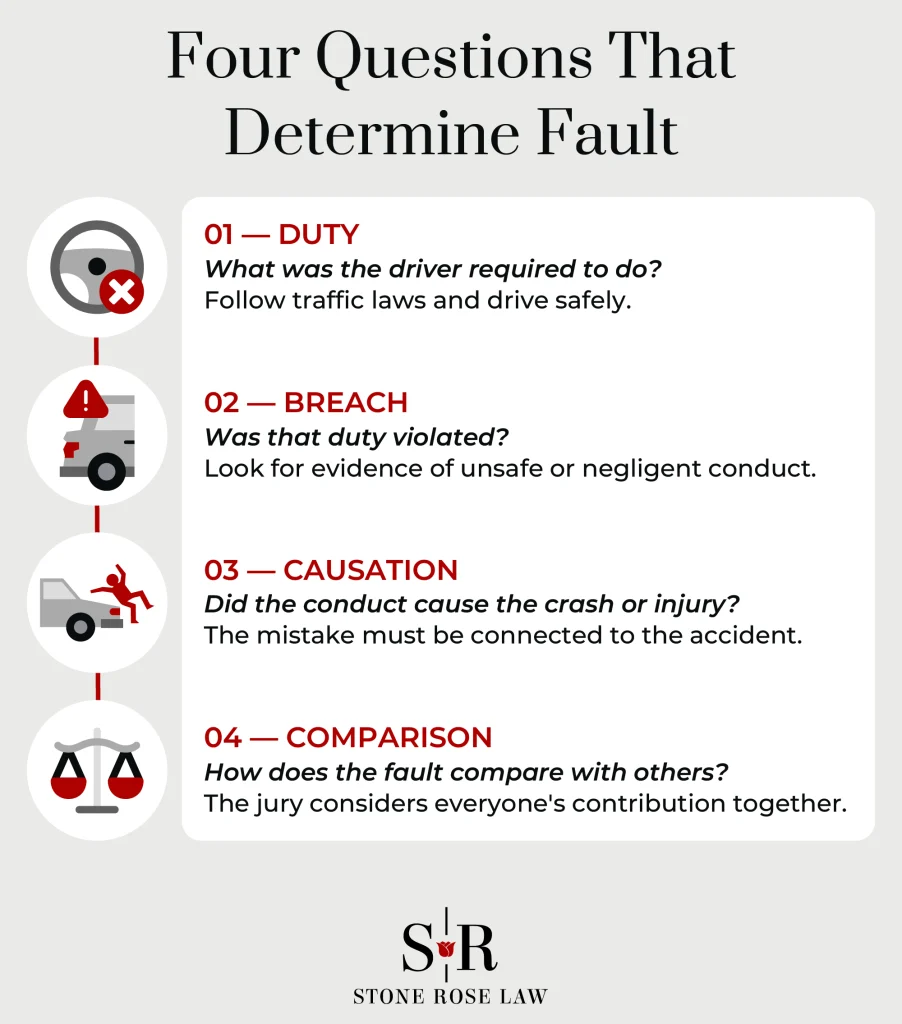
A sound fault analysis asks four questions about every potentially responsible person:
- What legal duty applied?
Examples may involve obeying a traffic signal, maintaining a safe following distance, yielding, keeping a proper lookout, or operating at a reasonable speed under the conditions. - What evidence shows a breach of that legal duty?
Statements, photographs, video, measurements, witness accounts, traffic-control information, and vehicle evidence may confirm or contradict the alleged driving error. - Did that conduct cause the collision or injury?
Fault under ARS 12-2506 requires proximate causation. This means that a mistake unrelated to the collision should not receive a percentage merely because it occurred near the same time. - How does that conduct compare with everyone else’s conduct?
Under ARS 12-2506(B) and (C), the jury evaluates the conduct of the claimant, defendants, and nonparties together rather than evaluating each person in isolation.
Evidence That Juries Consider in Assigning Fault
In a trial, the jury considers admissible evidence presented by the attorneys for their clients. Common types of evidence that have a bearing on the jury’s fault assignments include:
- Crash and investigative reports. These can identify the parties and witnesses and include a narrative and scene diagram.
- Accident scene photographs and video. Images may document lane position, debris, skid or tire marks, sight obstructions, traffic signals, lighting, weather, and vehicle resting positions.
- Vehicle damage and inspections. Damage location and crush patterns may help evaluate impact direction and disputed movement.
- Independent witnesses. Neutral witnesses may clarify signal phases, speed, lane changes, braking, or evasive action.
- Electronic information. Depending on availability and lawful access, dash-camera footage, nearby surveillance video, vehicle event data, navigation information, phone records, or commercial-vehicle records may all be relevant.
- Medical records. These generally address injury causation, timing, severity, and damages rather than who violated a traffic rule.
- Qualified experts. Accident reconstruction specialists, medical experts, or economic experts may be appropriate when the relevant issue requires specialized knowledge. The party attempting to allocate fault to a nonparty must still produce legally sufficient evidence.
Allocation of Fault
In a car accident case, at the conclusion of the trial, the jury will consider the evidence and assign fault to the parties it finds liable for causing the accident and its injuries. The jury will start with a 100% figure and break it down based on each responsible party’s share.
So, for example, if you file a lawsuit for injuries and property damage claims after a car accident and the jury finds that you were 20% at fault and the defendant 80% to blame, and your judgment award was for $20,000, then your award would be reduced by 20%, or $4,000, to a final award of $16,000.
There is no limit on how much fault can be assigned to you in your claim, outside of practical considerations. Theoretically speaking, the jury could find you 99% at fault, and you could still recover compensation for the remaining 1%.
The table below illustrates how the comparative fault calculation works.
|
Illustrative situation |
Full damages | Claimant’s fault | Other driver’s fault | Actual Recovery |
| The claimant bears minor fault. | $100,000 | 20% | 80% | $80,000 |
| The claimant is more than 50% at fault. | $100,000 | 55% | 45% | $45,000 |
| The claimant bears most of the fault. | $100,000 | 80% | 20% | $20,000 |
What if Several People Contributed to the Accident?
Multiple people can be partially responsible for the same vehicle accident, and not all of them need to be drivers. For example, let’s say that when you are traveling through an intersection, a commercial truck makes an illegal left-hand turn in front of you at an excessive speed. The load the truck is carrying shifts, causing the truck to tip over and hit your car.
Subsequent investigation shows that when the collision occurred, the driver of the truck was talking on the phone at the time of the accident, and that the contractor the trucking company hired to load the truck loaded its cargo improperly, and that the reason why the truck was traveling too fast was that its brakes were defective after a faulty repair by a third-party repair shop.
In this scenario, all of the following parties may share some of the blame for the intersection accident:
- The truck driver is negligent.
- The trucking company that employed the driver, potentially for conduct within the scope of employment, and, if supported by the evidence, negligent hiring or supervision.
- The cargo-loading contractor that the trucking company hired contributed to the load shift.
- The automotive repair facility for its faulty brake repair.
Even if you were not to blame, comparative negligence still applies in this case, and the jury could allocate what it concludes is the appropriate percentage of fault to each of these parties.
Note, however, that to be responsible for paying compensation, an at-fault party must be included in your personal injury action. In the above example, if you did not include the brake repair service, then even if the jury assigned it 20% of the fault, you would not receive compensation from it because it was not a named defendant in your lawsuit, and no judgment attaches to it.
A defendant asserting nonparty fault has the burden to present evidence of the nonparty’s duty, breach, and causation.
Arizona Usually Makes Each Defendant Pay Only That Defendant’s Assigned Share of Fault
In states that apply joint and several liability, a defendant may be responsible for the full amount of a judgment even when other defendants also share fault. Contribution rules may allow defendants to seek reimbursement from one another.
In Arizona, however, ARS 12-2506 generally abolishes joint liability in personal-injury, property-damage, and wrongful-death cases. The jury considers the fault of the claimant, defendants, and qualifying nonparties together, with their respective percentages totaling 100%.
Each defendant is ordinarily liable only for the damages corresponding to that defendant’s percentage. Some statutory exceptions exist, including certain agency relationships, persons acting in concert, and liability arising under the Federal Employers’ Liability Act.
Arizona appellate court decisions clarify how broadly the comparative fault allocation system can operate when allocating fault:
- Nonparties: Cramer v. Starr held that a defendant in a rear-end case could attempt to prove fault against a nonparty physician whose later treatment allegedly enhanced the plaintiff’s injuries. The defendant still bore the burden of proving the physician’s duty, breach, and causation; fault was not automatic.
- Unknown wrongdoers: Rosner v. Denim & Diamonds, Inc., permitted consideration of unidentified assailants when sufficient facts established their existence and involvement. The decision does not allow an insurer or defendant to invent an unsupported “phantom” tortfeasor.
- Different degrees of misconduct: Hutcherson v. City of Phoenix recognized that Arizona’s broad statutory definition permits comparison of negligent and intentional conduct. The jury’s allocation receives deference when supported by substantial evidence.
- Indivisible injuries: Piner v. Superior Court held that when multiple events cause an indivisible injury, the claimant need not perform an impossible division of physical damages. The factfinder determines total damages and allocates fault among the contributing actors; each defendant remains severally liable for that defendant’s percentage.
The Willful-or-Wanton Limitation on Comparative Fault
There are some ways in which your ability to recover compensation through a comparative negligence claim can be limited. The clearest example is if you were 100% at fault.
Otherwise, ARS 12-2505 removes the right to a proportionally reduced comparative award when the claimant acted intentionally, willfully, or wantonly.
ARS 12-2505 does not direct an automatic defense verdict if you acted willfully or wantonly. Instead, you lose the statutory right to a proportionally reduced comparative award. In Williams v. Thude, the Arizona Supreme Court approved an instruction that the jury should not compare relative fault but may find for either party as it deems fit; it rejected a mandatory all-or-nothing instruction.
For example, wanton conduct is a form of aggravated negligence. So, ordinary speeding, inattention, or a mistaken lane change does not become willful or wanton merely because a jury assigns a high allocation of fault to you.
The rule is different, however, when the defendant acted willfully or wantonly. Because ARS 12-2506 defines fault to include negligence in any form, Arizona courts permit a willful-or-wanton defendant’s fault to be compared with a negligent claimant’s fault.
How Do Adjusters Determine Who Is at Fault?
Most car crash personal injury cases settle out of court. So, instead of a jury, the decision of who is at fault and to what extent is often the subject of negotiations with a claim adjuster from the other driver’s insurance company.
Insurance companies determine fault by developing an initial liability allocation position based on the drivers’ accounts, witness statements, police materials, photographs, vehicle damage, medical information, traffic controls, and other reasonably available evidence.
Arizona’s insurance statute, ARS 20-461, prohibits claim denials without a reasonable investigation based on available information and requires a reasonable explanation of the factual, legal, or policy basis for a denial or compromise offer. Still, insurance adjusters work for their insurance company employers and thus have an interest in keeping insurance settlement payouts as low as possible.
This means that adjusters can be aggressive in seeking ways to maximize your supposed fault for the accident and minimize their insured’s. Examples of claim adjuster tactics can include:
- Isolating a brief or uncertain statement while discounting physical evidence.
- Treating a traffic citation or an officer’s preliminary conclusion as the complete civil-fault analysis.
- Assuming minimal visible vehicle damage means no injury occurred.
- Relying on a generic low-impact claim profile rather than an individualized investigation.
- Assigning fault to an unidentified driver or other nonparty without evidence of duty, breach, and causation.
- Using a disputed fault percentage to pressure you into accepting a reduced settlement.
A claim adjuster’s fault percentages are a negotiating position and not the same as a court judgment, and your personal injury attorney can contest them. If the parties do not settle and the case proceeds to trial, the jury (or the judge in a bench trial) will decide whether the claimant was negligent, whether that negligence caused the injury, and how fault should be allocated.
What Compensation May Be Available?
You can generally seek the same categories of compensatory damages after a partial fault car accident as in another personal injury case. For ordinary negligence, your recovery is reduced by your share of fault; the intentional, willful, or wanton conduct limitation discussed above is a separate exception.
Economic Damages
Economic damages compensate you for tangible losses, generally involving physical injury treatment, property damage, or, if you lose a loved one, possibly wrongful death damages.
Economic losses may include:
- Reasonable expenses for necessary past and future medical care and related medical expenses.
- Past lost wages.
- Reduced future earning capacity.
- Property damage, like vehicle repairs, is commonly measured by the difference between the property’s value immediately before and after the damage.
Noneconomic damages
Non-economic damages compensate you for intangible kinds of harm. These can be more challenging to prove than economic damages, but they can still be valuable.
Non-economic losses may include:
- Pain, discomfort, and suffering.
- Disability or disfigurement.
- Anxiety.
- Loss of enjoyment of life.
- In appropriate cases, loss of consortium that involves a spouse, parent, or child.
Arizona’s Constitution generally prohibits statutory caps on damages for personal injury or death. Its crime-victim exception protects victims against certain claims brought by people harmed while committing, attempting, or fleeing a felony.
What Should You Do After a Car Accident Involving Comparative Fault Claims?
After a partially at-fault auto accident, here are some practical steps you can take to preserve evidence and to strengthen your claim in settlement negotiations or trial.
- Obtain the police report of the accident, and preserve any photographs, video evidence, witness information, and vehicle evidence.
- Avoid admitting fault to anyone, including other drivers, witnesses, or insurance company representatives.
- Seek medical attention, and keep records of medical reports, treatment, restrictions, missed work, and expenses.
- Provide accurate factual information to police and insurance adjusters, but do not guess about speed, distance, timing, or fault.
- Ask the insurer to explain the facts supporting its proposed percentages of fault allocation.
- Look for possible nonparties, including vehicle owners, employers, contractors, roadway entities, or other drivers, when the evidence supports their involvement.
- Do not assume that an at-fault accident label on an insurance file ends the legal analysis.
- Address all deadlines before waiting for negotiations to conclude.
How Long Do You Have to File?
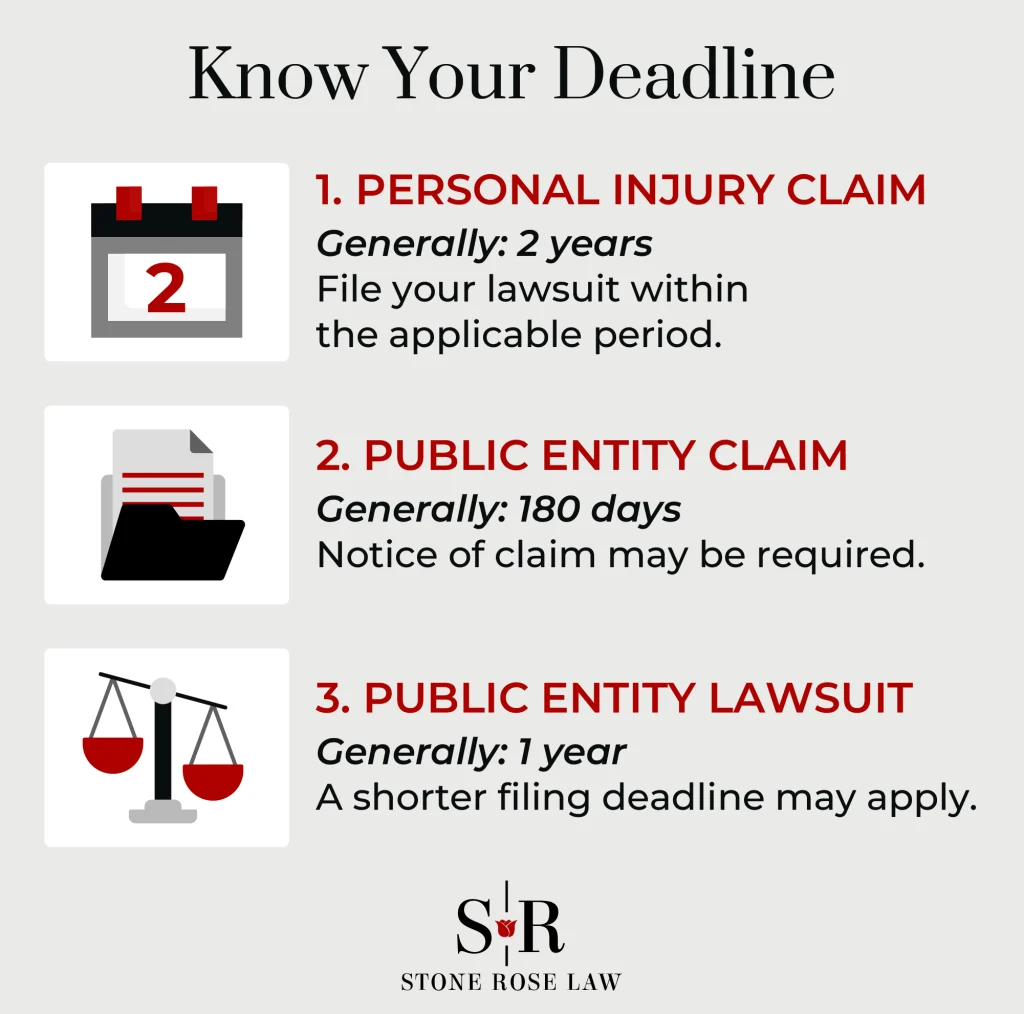
ARS 12-542 generally requires you to file an Arizona personal-injury lawsuit within two years after the claim accrues. The same section provides that a wrongful-death claim accrues at death.
Not every accident-related claim has the same deadline. Minority, qualifying mental incapacity, or delayed discovery may affect when the filing period begins or runs. These exceptions are fact-specific, so have an attorney calculate the deadline rather than assuming it is extended.
Claims against an Arizona public entity or public employee can involve much shorter requirements. ARS 12-821.01 generally requires you to file a notice of claim with the person authorized to accept service within 180 days after the claim accrues, and ARS 12-821 generally requires you to file suit within one year of the accrual date.
Talk With a Stone Rose Law Arizona Car Accident Attorney
Being accused of sharing fault in a car accident does not necessarily preclude you from making an Arizona personal injury claim. The important questions are what conduct actually caused the crash, what evidence supports each proposed percentage, whether anyone else contributed, and what damages can be proved.
If you have been harmed in a motor vehicle collision and are being accused of being at fault for it by the other driver’s insurer, then having a Stone Rose Law car accident lawyer on your side can make all the difference in helping you receive fair compensation.
Our experienced attorneys know how to deal with claim adjuster tactics and methods in fault assessments and are skilled at gathering the evidence you need to support your case and presenting it effectively, including preparing for litigation if settlement negotiations do not yield a satisfactory result.
Call our office at (480) 631-3025 to schedule an appointment with our law firm today, or use our online contact form. Don’t let an insurance company unfairly assign you a higher fault percentage in a car accident claim. Call Stone Rose Law today.
The post Can You Still Sue in a Partial Fault Car Accident? appeared first on Stone Rose Law.