
Possibly, but do not apply for or sign a title loan during Chapter 13 without first consulting your bankruptcy attorney. In Arizona, trustee consent and court approval depend on your plan status and the proposed transaction. A cash loan against a vehicle you already own requires Trustee approval and court motion under Local Rule 2084-25. The procedure depends on the status of your Chapter 13-whether you have a confirmed or unconfirmed case-and if the Trustee approves the acquisition of this loan.
Stone Rose Law bankruptcy attorneys Victoria Q Av and Estrella Aguilar represent Arizona residents in Chapter 13 bankruptcy proceedings. In this post, we consider how an ongoing Chapter 13 bankruptcy case can affect your ability to obtain a car title loan on your vehicle.
To learn more about how our law firm can help you understand title loans and your options under federal bankruptcy laws, and how local Arizona bankruptcy rules affect your legal rights, call our law office at (480) 739-2448 or contact us online.
What Is a Vehicle Title Loan?
The Arizona Department of Insurance and Financial Institutions describes a title loan as a secured debt personal loan made against the title to a motor vehicle. Arizona law similarly describes a “secondary motor vehicle finance transaction” as a transaction that obtains a security interest or lien on a vehicle outside the sale of that vehicle.
In contrast to unsecured debt like credit card debt or a personal loan, with a title loan, you receive cash in exchange for giving the lender a secured interest (typically a lien) in your vehicle. Your vehicle becomes the lender’s collateral on the loan. You get to keep using the vehicle while you pay off the remaining loan balance.
Title loans are usually a last resort for people whose creditworthiness is not good enough to qualify them for more conventional loans. They tend to be expensive for borrowers, with high interest rates and short repayment periods. If you do not repay the loan according to its terms, then the lender may take possession of it.
How Can a Vehicle Title Loan Relate to Chapter 13?
The cornerstone of Chapter 13 bankruptcy is your monthly debt repayment plan, through which you pay back at least part of the amounts you owe your creditors. A key consideration in being allowed to use Chapter 13 is your ability to show that you have a steady source of income for the duration of the plan period, which is three to five years.
Losing your vehicle to a title loan creditor can become the start of a cascading series of follow-on consequences that, if you are using Chapter 13 debt relief, can put your debt repayment plan at risk.
Consider the following chain of events:
- If you are struggling on a tight monthly budget, then it can become easy to fall behind on a vehicle title loan.
- If you lose your vehicle to a title loan lender by default in a collection action, it can keep you from getting to and from work.
- If you cannot go to work, you can lose your job.
- Losing your source of employment income can threaten your financial stability.
So, from the point of view of the bankruptcy trustee, anything that could threaten your ability to stick with your payment plan is going to warrant scrutiny. This includes taking on new title loan debt.
Arizona Local Rule 2084-25 Controls New Borrowing
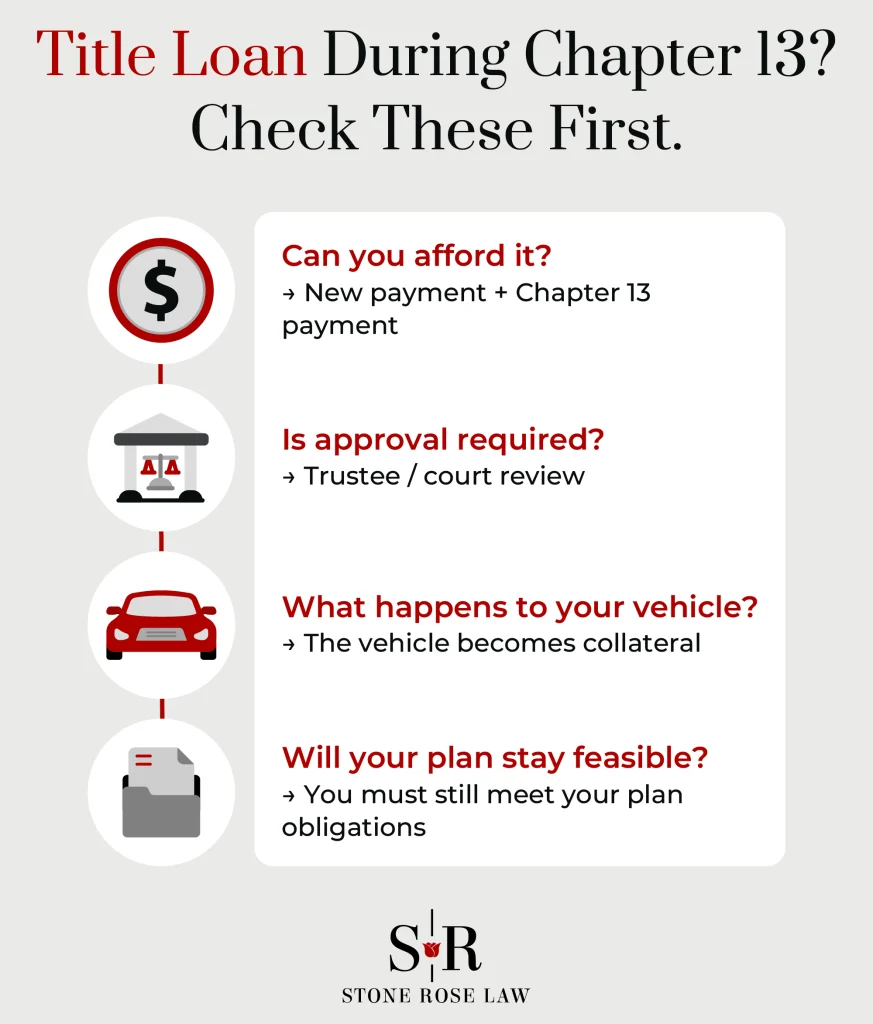
Federal bankruptcy laws are supplemented by local rules adopted by the federal bankruptcy court. The current District of Arizona local rules, revised through June 2026, cover pre-confirmation and post-confirmation borrowing. For our purposes here, Arizona Local Bankruptcy Rule 2084-25 governs the process for incurring new debt during Chapter 13.
Approval is case-specific and is never guaranteed. The trustee assigned to your case, the bankruptcy court judge, your plan status, your budget, the confirmation order (if there is one), and the proposed contract may all affect the approval or denial of consent. For example, published Arizona trustee guidance directs debtors not to incur new debt before seeking approval and emphasizes that you should address any new debt-related concerns through your bankruptcy attorney.
Borrowing Before Chapter 13 Plan Confirmation
Local Rule 2084-25(a) provides a streamlined process for certain new debts when the Chapter 13 trustee consents pre-confirmation.
As a debtor, you must file a motion with the bankruptcy court seeking an order approving the new debt, with the trustee’s consent for the streamlined procedure.
Are Your Chapter 13 Plan Payments Current?
For the pre-confirmation procedure, Rule 2084-25 expressly requires you to be current on your plan payments and not in default under the plan. A request made while payments are delinquent is therefore likely to face resistance from the trustee.
Do You Have Current Proof of Income?
The Arizona local rule requires current income verification. It also requires that Schedules I and J be filed within the prior 30 days, showing your income and expenses. Depending on the trustee and the facts, supporting information may include recent pay statements, documentation of other income, and an updated household budget.
The exact document submission process can differ among trustees, so your bankruptcy attorney should confirm what the assigned trustee requires.
Can You Repay the Title Loan and Still Complete the Payment Plan?
Your budget must demonstrate your ability to pay the new loan obligation while continuing all plan payments and reasonable living or business expenses. This is consistent with the U.S. Bankruptcy Code’s feasibility requirement: a Chapter 13 plan must be one under which you can make all required payments and comply with the plan.
A proposed loan payment that consumes the funds needed to pay your mortgage, utilities, insurance, food, or Chapter 13 payment may undermine your motion request.
Are the Loan Amount and Terms Reasonable?
Arizona Local Bankruptcy Rule 2084-25 expressly provides streamlined procedures for certain vehicle-purchase loans, home-purchase loans, and refinancing transactions. A title loan secured by an already-owned vehicle may not fit within those categories and may require additional court review.
The trustee or court may also consider whether a less expensive or less risky way exists to address the expense. Arizona’s permitted monthly title-loan finance rates make it especially important to examine the entire contract rather than focusing only on the amount of cash offered.
What Lien Will the Proposed Lender Receive?
Your attorney will need to review the vehicle’s value, existing liens, available equity, the proposed lender’s lien position, insurance requirements, and how the lien could affect your bankruptcy plan and continued transportation needs.
If the vehicle already secures another loan being treated in the Chapter 13 plan, adding or replacing a lien can create additional legal and practical issues. The new lender’s proposal should therefore be reviewed before the debtor authorizes a title filing or signs documents.
If the trustee consents and the requirements of Rule 2084-25 are satisfied, you may obtain court approval through the rule’s streamlined procedure.
If trustee consent is denied or the transaction falls outside the streamlined requirements, Rule 2084-25(d) permits a court motion, service on the trustee and on creditors entitled to notice, and a hearing to be set with the required notice.
After Chapter 13 Plan Confirmation
In a confirmed case, Rule 2084-25(c) allows you to request the trustee’s written consent by providing the information that would be required in the motion you would make in an unconfirmed case, subject to the following considerations:
- After confirmation, your payment history remains important. Federal law allows dismissal or conversion for a material default under a confirmed plan, and the current Arizona rules authorize a trustee to seek dismissal if you fail to make timely plan payments or comply with a confirmed plan.
- A post-confirmation plan modification can alter certain payment amounts or payment periods, but it is subject to notice, potential objection, and statutory confirmation requirements. A modification is not automatically granted simply because you have taken on a new obligation.
- If the vehicle already secures another loan being treated in the Chapter 13 plan, adding or replacing a lien can create additional legal and practical issues. The new lender’s proposal should therefore be reviewed before the debtor authorizes a title filing or signs documents.
If the proposed title loan falls outside the streamlined procedure, follow the court-motion-and-notice process described above under Rule 2084-25(d).
Existing Title Loan Obligations
If you already have an outstanding title loan, Chapter 13 bankruptcy allows you to include this debt in your restructured repayment plan. Depending on the facts of the case and applicable Bankruptcy Code provisions, some secured vehicle claims may be paid through the plan based on the value of the collateral rather than the full debt amount.
Your payment plan may include a lower interest rate and a reduced principal balance, making the repayment more manageable. Any remaining debt after the repayment period may sometimes be discharged.
Risks of Taking a Title Loan During Chapter 13
As we indicated above, when you seek to take on a vehicle title loan while you are using Chapter 13, this can introduce an element of uncertainty that the bankruptcy trustee will scrutinize. Here are some important considerations.
The Vehicle Becomes Collateral for Another Debt
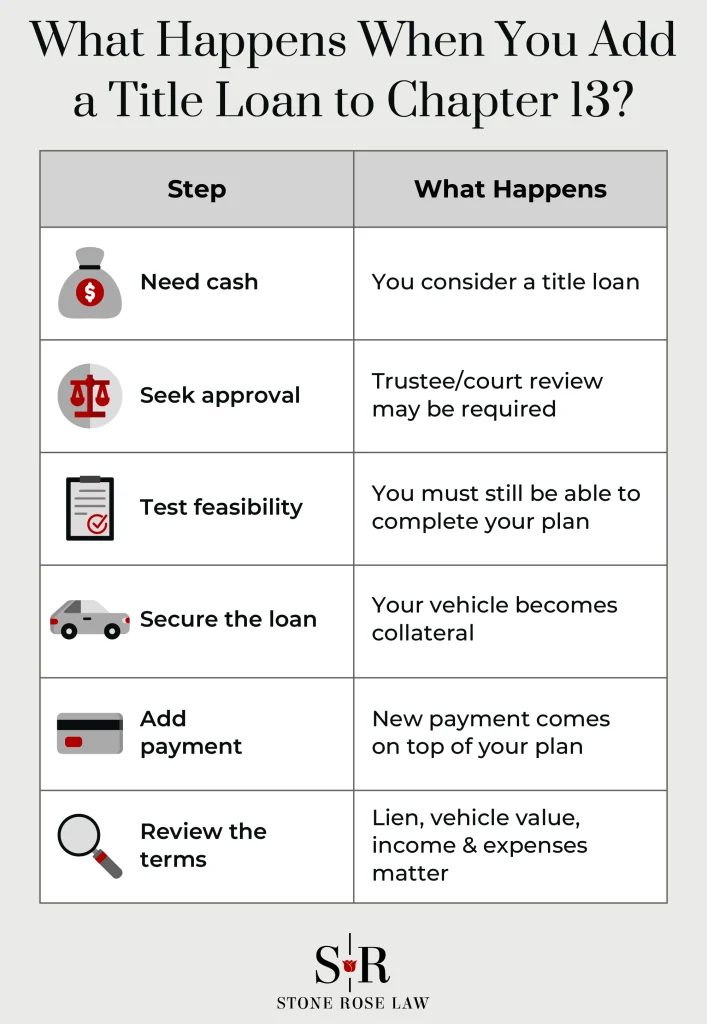
A title loan puts your vehicle at risk of loss, which can put your ability to get to work at risk, too. Arizona law permits a secured creditor, such as a title loan lender, to take possession of collateral after default, subject to applicable legal requirements, and, in a bankruptcy case, may seek court permission to proceed against the collateral when appropriate.
The New Payment May Destabilize Your Chapter 13 Plan
You must continue making payments under your payment plan even after obtaining new credit. The title loan payment does not replace the plan payment; it is in addition to it. If the new obligation causes missed plan payments, then the trustee may object, seek a modified arrangement, or request dismissal of your case.
The Loan May Cost Far More Than Expected
Arizona’s statutory monthly finance rate ceilings for secondary motor vehicle finance transactions are high enough that you should examine your total repayment obligation carefully. Fees, renewals, and repeated borrowing can increase the strain on a household budget already committed to a Chapter 13 plan.
What if You Take Out a Title Loan Without Approval?
An unauthorized title loan does not automatically result in dismissal, but possible consequences may include:
- The trustee declining to consent to the loan after the fact
- An objection to plan confirmation or to a proposed plan modification
- A requirement to disclose the transaction, update financial information, or seek retroactive or other appropriate relief
- A dispute over whether the new payment makes your payment plan infeasible
- A motion to dismiss your Chapter 13 or convert it if the borrowing contributes to a material plan default
- Continued personal responsibility for a debt that is not properly addressed or discharged in the bankruptcy case.
Alternatives to Discuss Before Using a Title Loan
Before risking your vehicle with a title loan, an Arizona Chapter 13 lawyer can help you consider other options that may work better for your financial challenges.
- A plan modification. If your income has fallen or your necessary expenses have increased, Bankruptcy Code Section 1329 may permit changes to your plan payment amounts or timing, subject to notice and approval.
- Temporary relief within the bankruptcy case. Depending on the circumstances, your bankruptcy attorney may be able to request appropriate court relief rather than adding a high-cost secured loan.
- A lower-cost, specifically authorized loan. A credit union, bank, family, employer, or other lender may offer more practical terms for you and a longer period for repayment.
- Repairing the existing vehicle instead of borrowing against its title. If transportation is the problem, your lawyer can help you evaluate whether paying for repairs or obtaining properly approved repair financing would preserve your vehicle without creating a title loan lien.
- Non-debt assistance. Available insurance proceeds, public or nonprofit assistance, or help from family may avoid a new secured loan obligation.
- Replacement vehicle financing when genuinely necessary. A necessary vehicle purchase may fit the express vehicle-loan provisions of Arizona Rule 2084-25 more readily than a cash title loan, although approval remains case-specific and is not guaranteed.
Consult With a Stone Rose Bankruptcy Attorney Before You Apply for or Sign a Vehicle Title Loan
If you are already in Chapter 13 and need additional funds, an experienced bankruptcy attorney can help you assess your options before you risk your vehicle or repayment plan.
A title lender’s willingness to make a loan does not mean the bankruptcy trustee or the court will approve it. Before submitting an application, signing a promissory note, accepting funds, or allowing a lien to be placed on your vehicle, we recommend you talk with an experienced Chapter 13 bankruptcy lawyer about the following:
- The reason you need the money
- The proposed loan agreement and disclosures
- The amount financed and the total repayment terms
- The proposed monthly payment
- The vehicle’s value and current title or lien information
- Recent proof of income
- An accurate list of your current household expenses
Loan approval by the bankruptcy trustee depends on the facts of your individual case and is not guaranteed. Trustee procedures can also vary.
Call Stone Rose Law at (480) 739-2448 or use our online contact form before applying for or signing a title-loan agreement. In a free consultation, one of our Arizona bankruptcy attorneys can review the proposed transaction, communicate with the trustee, and determine whether trustee consent, a court motion, or another solution is appropriate for you.
The post Can I Get a Title Loan While in Chapter 13? appeared first on Stone Rose Law.