
The post Kent Berk Appeared on Money Radio with Bob Roth on April 24, 2020 appeared first on Berk Law Group, P.C..
Continue Reading Kent Berk Appeared on Money Radio with Bob Roth on April 24, 2020
Latest from Berk Law Group Blog - Page 6
Federal Government Enhancing Criminal Prosecution of Nursing Home Abuse

The United States is growing old! The National Academy of Sciences Engineering Medicine reports that the number of U.S. citizens ages 65 and older is going to nearly double from 2017 to 2060. Twenty percent of our country will be over age 60 by 2030, and, for the first time in history, by the year 2034 there will be more people over age 65 than under the age of 18. We are also seeing this trend in Arizona. The U.S. Census Bureau estimates that more than a quarter of Arizona’s population will be over age 60 by the year 2030.
Continue Reading Federal Government Enhancing Criminal Prosecution of Nursing Home Abuse
Berk Law Group is Open and Accepting New Matters – Safely
The past several weeks have tested us all. While the near future remains uncertain, we will surely prevail over our current crisis. We wish you all the best of health, safety, strength and peace during these trying and unprecedented times!As we continue to monitor and adjust to ongoing developments caused by the Coronavirus (COVID-19), nothing will compromise our commitment to keep our employees and clients safe, while still taking care of the matters that our clients trust our firm to handle.
We have plans in place to continue to provide exceptional, uninterrupted service to our existing and potential clients. To
We have plans in place to continue to provide exceptional, uninterrupted service to our existing and potential clients. To
Continue Reading Berk Law Group is Open and Accepting New Matters – Safely
COVID-19 Resources for Maricopa County, Arizona Attorneys

As we continue to monitor and adjust to ongoing developments caused by the Coronavirus (COVID-19), we have compiled a list of and links to Administrative Orders, Executive Orders and other resources helpful to attorneys practicing in Maricopa County, Arizona. We will monitor new developments and try to keep the list updated. Please let us know if you are aware of something that we should include.
Arizona Governor Ducey’s Executive Orders
- March 25, 2020 Order Re: Expansion of Telemedicine
- March 24, 2020 Order Re: Postponement of Eviction Actions
- March 23,2020 Order Prohibiting the Closure of Essential Services
- March 19,2020 Order Limiting
Continue Reading COVID-19 Resources for Maricopa County, Arizona Attorneys
Power to Control Disposition of Remains

The death of a loved one is traumatic enough. Disputes over the power to control the disposition of remains in Arizona only adds to the stress. So, what happens when a person dies without leaving clear instructions for cremation or burial of his remains? Who gets to decide?
Ghostley- Decedent’s Remains In Purgatory
In the Matter of the Remains of James David Ghostley, Deceased, No. 2 CA-CV 2018-0197, January 22, 2020, these questions were the topic of a Division Two Arizona Court of Appeals decision.
After their son, Mr. Ghostley, died in 2018, his divorced parents disagreed about the
Continue Reading Power to Control Disposition of Remains
Settlement Agreement Unenforceable if Not Signed by All Beneficiaries

Settlement agreements are an often used alternative to lengthy, expensive probate, trust and estate litigation and trial in Arizona. A settlement agreement is typically a binding agreement that usually disposes of the case without further litigation.
Under most circumstances, only parties to the agreement will be bound by the terms of a settlement agreement. This method of resolution may get sticky when the litigation involves the trustee or trustees of a trust and some of the trust beneficiaries, but not all of them. Further issues may arise if the trustees agree to resign and be replaced by a successor trustee
Continue Reading Settlement Agreement Unenforceable if Not Signed by All Beneficiaries
Settlement Agreement Unenforceable if Not Signed by All Beneficiaries

Settlement agreements are an often used alternative to lengthy, expensive probate, trust and estate litigation and trial in Arizona. A settlement agreement is typically a binding agreement that usually disposes of the case without further litigation.
Under most circumstances, only parties to the agreement will be bound by the terms of a settlement agreement. This method of resolution may get sticky when the litigation involves the trustee or trustees of a trust and some of the trust beneficiaries, but not all of them. Further issues may arise if the trustees agree to resign and be replaced by a successor trustee
Continue Reading Settlement Agreement Unenforceable if Not Signed by All Beneficiaries
Interest or No Interest – Interesting Issue in Arizona Probate Claims

Under Arizona law, at the time of appointment, the personal representative of an estate must provide notice to creditors, known and unknown. For unknown creditors, the personal representative must publish a notice to creditors in a newspaper of general circulation in the county where the decedent lived. For known creditors, the personal representative must give notice by mail or other delivery.
Creditors of the estate then have four months after publication or sixty days after the mailing or other delivery of the notice, whichever is later, to present their claims. A.R.S. § 14-3801. Claims may then be allowed or
Continue Reading Interest or No Interest – Interesting Issue in Arizona Probate Claims
Interest or No Interest – Interesting Issue in Arizona Probate Claims

Under Arizona law, at the time of appointment, the personal representative of an estate must provide notice to creditors, known and unknown. For unknown creditors, the personal representative must publish a notice to creditors in a newspaper of general circulation in the county where the decedent lived. For known creditors, the personal representative must give notice by mail or other delivery.
Creditors of the estate then have four months after publication or sixty days after the mailing or other delivery of the notice, whichever is later, to present their claims. A.R.S. § 14-3801. Claims may then be allowed or
Continue Reading Interest or No Interest – Interesting Issue in Arizona Probate Claims
When Helping Yourself Doesn’t Help

The Arizona probate process is strictly governed by laws enacted by the legislature and by rules adopted by the Arizona Supreme Court. Individuals are not prohibited from entering into this technical area, but there are many pitfalls out there.
The Arizona Court of Appeals recently decided a case that illuminates the perils of self-help. In the Matter of the Estate of Norma Jean McConnell, her son filed several documents with the court that he had created himself, demanding to be appointed as the personal representative to administer her estate under her last will and testament.
The Judge could have dismissed
Continue Reading When Helping Yourself Doesn’t Help
When Helping Yourself Doesn’t Help

The Arizona probate process is strictly governed by laws enacted by the legislature and by rules adopted by the Arizona Supreme Court. Individuals are not prohibited from entering into this technical area, but there are many pitfalls out there.
The Arizona Court of Appeals recently decided a case that illuminates the perils of self-help. In the Matter of the Estate of Norma Jean McConnell, her son filed several documents with the court that he had created himself, demanding to be appointed as the personal representative to administer her estate under her last will and testament.
The Judge could have dismissed
Continue Reading When Helping Yourself Doesn’t Help
2018 Probate and Trust Legislation Update
The process of transferring property from a deceased person to his or her beneficiaries is governed by Arizona statutes. Although the general procedures in Arizona are similar to those in most other states because of the adoption of the Uniform Probate Code and the Uniform Trust Code, most states make their own tweaks and changes.
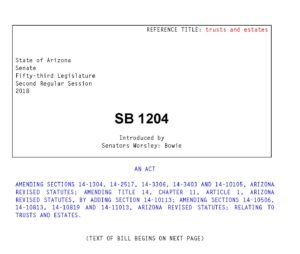
Senate Bill 1204 was introduced to the 2018 Arizona 53rd Legislature, 2nd Regular Session, to address several issues affecting probate and trust administration and to make some changes to Arizona’s version of the uniform laws. The Bill was passed by both houses of the legislature
Continue Reading 2018 Probate and Trust Legislation Update
2018 Probate and Trust Legislation Update
The process of transferring property from a deceased person to his or her beneficiaries is governed by Arizona statutes. Although the general procedures in Arizona are similar to those in most other states because of the adoption of the Uniform Probate Code and the Uniform Trust Code, most states make their own tweaks and changes.
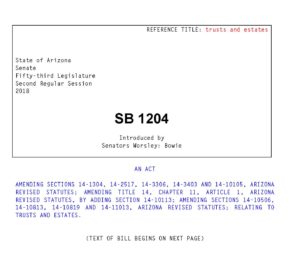
Senate Bill 1204 was introduced to the 2018 Arizona 53rd Legislature, 2nd Regular Session, to address several issues affecting probate and trust administration and to make some changes to Arizona’s version of the uniform laws. The Bill was passed by both houses of the legislature
Continue Reading 2018 Probate and Trust Legislation Update
Can I have a witness?
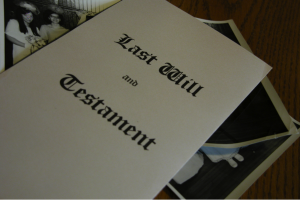
Arizona’s Revised Statutes (A.R.S.) set out the standards that must be met in order to create a last will and testament. Options include a handwritten or holographic will and a properly witnessed prepared will.
A.R.S. § 14-2502(A)(3) requires that, in the second case, a will be signed by the testator (maker of the will) and be “[s]igned by at least two people, each of whom signed within a reasonable time after that person witnessed either the signing of the will or the testator’s acknowledgment of that signature or acknowledgment of the will.” But who is a proper witness?
Most
Continue Reading Can I have a witness?
Can I have a witness?

Arizona’s Revised Statutes (A.R.S.) set out the standards that must be met in order to create a last will and testament. Options include a handwritten or holographic will and a properly witnessed prepared will.
A.R.S. § 14-2502(A)(3) requires that, in the second case, a will be signed by the testator (maker of the will) and be “[s]igned by at least two people, each of whom signed within a reasonable time after that person witnessed either the signing of the will or the testator’s acknowledgment of that signature or acknowledgment of the will.” But who is a proper witness?
Most
Continue Reading Can I have a witness?
Maricopa County Bar Association – February Probate Fundamental Continuing Legal Education Series

The Maricopa County Bar Association Estate Planning Probate and Trust (EPPT) Section announced its February estate planning probate and trust fundamental continuing legal education series. This four-part series is a great introduction to estate planning probate and trust law taught by experienced lawyers and an easy way to get 6 hours of your continuing legal education hours this year.
Register today at the Maricopa County Bar Association.
Fri 2/2/2018 12:00 PM – 1:30 PM
Fri 2/9/2018 12:00 PM – 1:30 PM