
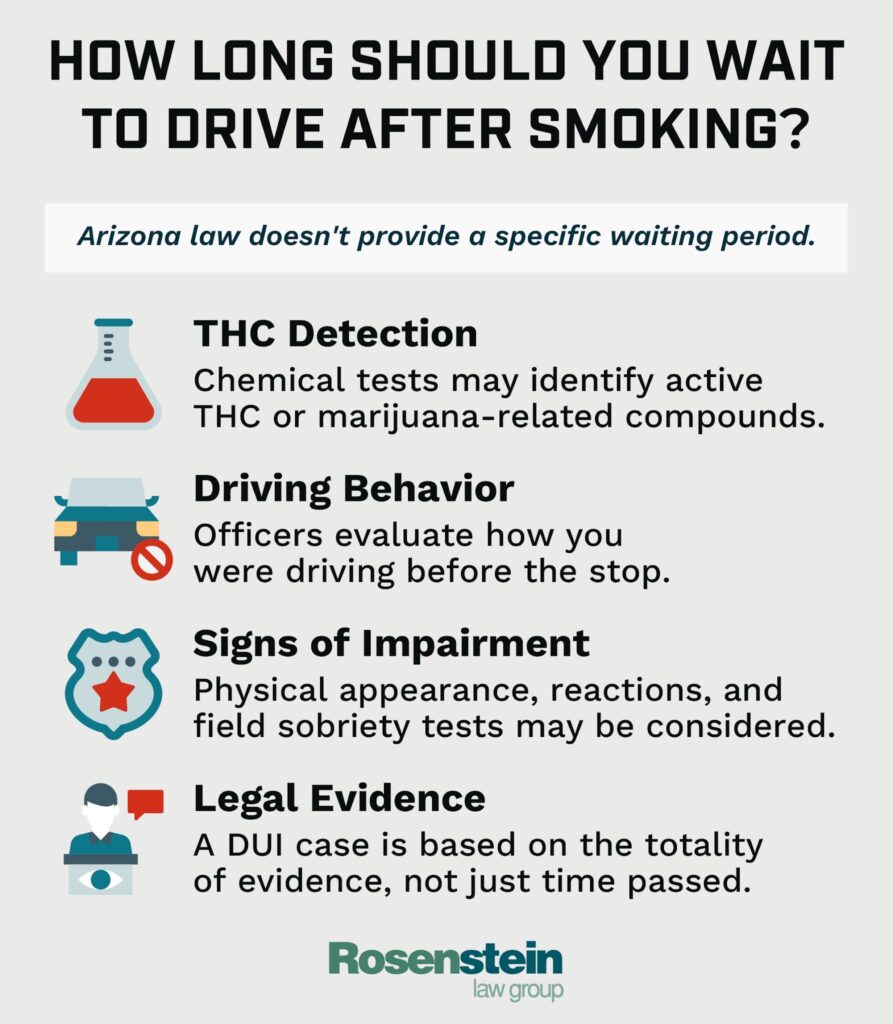
There is no single answer to how long after you smoke you can get a DUI in Arizona. There is no safe waiting period and no fixed number of hours after smoking, vaping, or consuming marijuana that protects a driver from a DUI charge.
The impairing effects usually fade within a few hours, but that is not the same as being impaired to the slightest degree under ARS 28-1381.
Active THC can remain detectable in blood for a day or more, in saliva for roughly one to three days, and in urine for several days to a month or longer in frequent users. Because marijuana can linger long after any high has worn off, a driver can still face a DUI investigation hours or even days after the last use.
Rosenstein Law Group provides criminal defense representation in marijuana DUI matters across Arizona.
Call (480) 248-7666 for a free consultation.
Marijuana Legalization Does Not Prevent a DUI Charge
Arizona legalized recreational marijuana for adults through Proposition 207. That legalization changed possession and adult-use laws, but it did not legalize impaired driving.
A person may lawfully possess or consume marijuana and still be charged with DUI if police believe marijuana affected their ability to drive. Legal use and lawful driving are separate issues under Arizona law.
Medical marijuana status also does not provide automatic immunity from DUI prosecution. A medical marijuana card may explain lawful access to marijuana, but Arizona does not treat marijuana legalization as a defense to impaired driving.
Arizona DUI Law for Marijuana Cases
Arizona marijuana DUI cases are commonly prosecuted under two subsections of Arizona’s DUI statute.
ARS 28-1381(A)(1) applies when a person is impaired to the slightest degree by alcohol, drugs, vapor-releasing substances, or any combination of those substances. ARS 28-1381(A)(3) addresses driving with certain drugs or their metabolites in the person’s body.
Together, these provisions create two different but related issues:
- Whether the driver was actually impaired
- Whether chemical evidence supports a legally valid DUI theory
This structure is one reason marijuana DUI cases are more technical than many people expect. Cases usually involve driving behavior, officer observations, chemical testing, toxicology, timing of use, and statutory interpretation.
Marijuana Metabolites and Arizona DUI Law
Marijuana cases are complicated because THC and marijuana metabolites are not all the same.
Active THC is the compound most closely associated with marijuana’s psychoactive effects. Other compounds may remain in the body after the impairing effects have worn off. Some metabolites are inactive and do not establish that a person was impaired while driving.
Before Arizona case law narrowed the issue, prosecutors often relied on the presence of any/all marijuana metabolites to support DUI charges, even where those metabolites were not active nor impairing. That created the risk of DUI prosecution based on residual chemical traces rather than actual impairment.
This distinction matters because marijuana metabolites can remain detectable after a person is no longer experiencing the same psychoactive effects. A test result may show prior marijuana use without proving impaired driving.
Dobson v. McClennen and the Current Rule
The Arizona Supreme Court addressed the metabolite problem in State ex rel. Montgomery v. Harris in 2014. The court held that the presence of a non-impairing metabolite, such as Carboxy-THC, cannot by itself support a DUI conviction.
The key legal distinction is between evidence of impairment or active influence and evidence of inactive chemical remnants that can linger for weeks and even months.
A year later, in Dobson v. McClennen, the court turned to medical marijuana patients. A valid medical marijuana card does not by itself block a DUI charge. Still, a registered patient may raise an affirmative defense by showing that the marijuana or its metabolite was in a concentration too low to cause impairment.
These rulings did not eliminate marijuana DUI enforcement in Arizona. Police and prosecutors still pursue marijuana DUI charges where there is evidence of impairment, active THC, recent use, poor driving, failed field sobriety tests, admissions, or other facts supporting the allegation.
The practical result is that marijuana DUI cases often require a closer look at what the chemical test actually found. A positive result is not the end of the analysis. The type of compound detected, the testing method, and the surrounding facts all matter.
Why There Is No Safe Waiting Period After Smoking
There is no single timeframe that determines when marijuana use becomes legally irrelevant for DUI purposes in Arizona.
A person who smokes marijuana may feel the effects quickly. Those effects may decline over time, but the rate of decline does not affect everyone equally.
Frequency of use, tolerance, dosage, THC concentration, metabolism, and the method of consumption can all affect how long marijuana remains relevant in a DUI investigation.
The question is not simply whether the person waited one hour, three hours, or six hours. The question is whether the evidence suggests impairment or a legally significant drug presence at the time of driving.
Chemical Testing in Marijuana DUI Cases
Blood testing is commonly used in DUI investigations to identify active THC and other marijuana-related compounds. Active THC levels usually peak and then fall within a few hours of use, but they may remain detectable for a day or more, and sometimes up to a week in frequent or heavy users.
Blood evidence can be important, but it still requires interpretation. THC levels do not rise and fall in the same way for every person.
Urine testing usually detects metabolites rather than current impairment. A urine result may show prior marijuana use, but it may not prove that the person was impaired while driving.
This is especially important for frequent users. Marijuana metabolites can remain detectable in urine for several days after occasional use, and for 30 days or more in someone who uses daily. A result that is far removed from the time of driving says little about impairment behind the wheel.
Saliva testing may be associated with more recent use, but it also has limitations. Oral fluid generally indicates use within the past 1 to 3 days, which is why it is sometimes used in roadside screening. The reliability and meaning of the result may depend on the timing of the test, the product used, the person’s metabolism, and the testing method.
In any marijuana DUI case, the defense must examine what was tested, what was detected, how the sample was collected, whether proper procedures were followed, and whether the prosecution is overstating what the result actually indicates or suggests.
Penalties for Marijuana DUI in Arizona
A marijuana DUI conviction in Arizona can carry serious penalties.
Potential consequences may include:
- Jail time
- Fines and surcharges
- Probation
- Mandatory screening or treatment
- Driver’s license consequences
- Ignition interlock issues in some cases
- A permanent or long-term criminal record
- Increased penalties for prior DUI offenses
The consequences may also extend beyond the court case. A conviction can affect employment, professional licensing, car insurance, security clearances, immigration status, and future background checks.
Prior DUI history, the facts of the stop, the test results, and the specific charge all affect the potential outcome.
What Police Look for in Marijuana DUI Investigations
Marijuana DUI investigations usually involve more than a chemical test. Common evidence may include:
- Driving behavior before the traffic stop
- The reason for the stop
- Odor of marijuana
- Physical signs the officer associates with impairment
- Statements about marijuana use
- Field sobriety test performance
- Drug recognition evaluation findings
- Blood, urine, and/or saliva test results
- The timing of alleged marijuana use
- The presence of marijuana or paraphernalia in the vehicle
A marijuana DUI case is usually built through cumulative evidence.
Legal Representation for Marijuana DUI Charges
Marijuana DUI charges are not just about whether marijuana was used. Effective defense strategies have to account for every aspect of the case.
Rosenstein Law Group represents clients facing marijuana DUI charges in Scottsdale, Phoenix, and throughout Maricopa County. The firm evaluates the evidence, challenges unsupported impairment claims, reviews chemical testing issues, and works to protect clients from the criminal, licensing, and long-term consequences of a DUI conviction.
If you were arrested or charged with a marijuana DUI in Arizona, call Rosenstein Law Group today at (480) 248-7666 for a free consultation.
The post How Long After You Smoke Can You Get a DUI in Arizona? appeared first on Scottsdale DUI Lawyers.