
Individuals can technically file bankruptcy without a lawyer, or pro se. However, filing bankruptcy without a lawyer is rarely a good idea.
Bankruptcy has strict requirements. A single mistake can lead to dismissal, lost assets, and long-term financial consequences.
Stone Rose Law helps Arizona debtors understand their bankruptcy options before they file.
If you are considering Chapter 7 or Chapter 13, call Stone Rose Law or use our online contact form to schedule a free consultation with a bankruptcy attorney.
What Does Pro Se Bankruptcy Mean?
Pro se bankruptcy means a debtor files a bankruptcy petition without a lawyer. Individuals are legally permitted to file bankruptcy pro se, but the bankruptcy court still expects them to follow the same rules as represented debtors.
A pro se debtor must prepare the petition, complete all required forms, list creditors, disclose assets, apply exemptions, pay the filing fee or request filing-fee relief, complete credit counseling, attend the 341 meeting, and complete debtor education before discharge.
Court staff can explain basic procedures, but they cannot give legal advice. They cannot tell a debtor which exemptions to use, whether Chapter 7 or Chapter 13 is better, how to respond to a trustee, or how to protect a home, car, retirement account, or other assets.
Why Filing Bankruptcy Without a Lawyer Is Risky
The main issue with pro se bankruptcy is that mistakes can be expensive and difficult to fix after the case is filed.
Some mistakes cannot be undone at all. Once a trustee sells a non-exempt asset, or a deadline to claim an exemption passes, that property—and the protection that went with it—is usually gone for good, even if the debtor later hires a lawyer.
Common risks include:
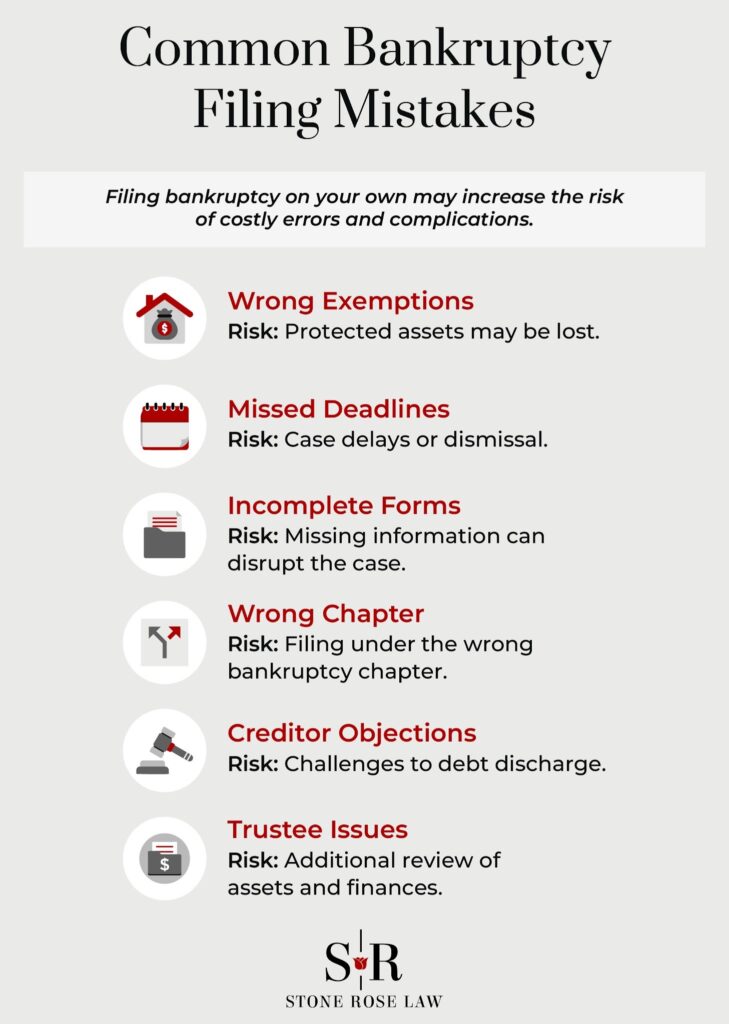
- Wrong exemptions: A debtor may fail to protect a home, car, retirement funds, tools, or other assets.
- Missed deadlines: Missing a court deadline can result in dismissal or the loss of rights.
- Incomplete petition: Missing forms, schedules, signatures, or financial information can delay or damage the case.
- Wrong chapter: Filing Chapter 7 when Chapter 13 is better, or filing Chapter 13 without a workable plan, can create serious problems.
- Creditor objections: A creditor may object to discharge or challenge how a debt is treated.
- Trustee action: A trustee may question transfers, asset values, income, exemptions, or missing documents.
These risks are why U.S. Courts say individuals may file bankruptcy without an attorney, but strongly recommend seeking qualified legal advice. Bankruptcy has long-term financial and legal consequences.
Filing for Chapter 7 Bankruptcy Without a Lawyer
Filing bankruptcy without a lawyer may be possible in a very simple Chapter 7 case. Even then, the debtor should understand the risk before filing pro se.
A simple Chapter 7 case may involve:
- No home ownership
- No valuable non-exempt assets
- Little or no equity in a car
- No business ownership
- No recent transfers
- No expected settlement or inheritance
- No creditor likely to object
- Clear means test eligibility
- No prior bankruptcy complications
However, Chapter 7 debtors must still pass the means test or qualify for an exception. The debtor must also disclose income, expenses, creditors, assets, transfers, lawsuits, bank accounts, vehicles, retirement funds, and other property.
If the debtor has non-exempt assets, the trustee may sell them and use the proceeds to pay creditors. This is one of the biggest reasons to speak with a bankruptcy attorney before filing Chapter 7.
Filing for Chapter 13 Bankruptcy Without a Lawyer
Chapter 13 is much harder to file without an attorney. A Chapter 13 debtor must propose a repayment plan and make plan payments for three to five years.
Chapter 13 may involve mortgage arrears, car loans, tax debt, priority debt, secured creditors, unsecured creditors, disposable income calculations, creditor objections, and trustee review. The plan must meet bankruptcy court requirements before it can be confirmed.
The pro se dismissal rate is a serious concern in Chapter 13. Studies have found that the vast majority of Chapter 13 cases filed without a lawyer never reach discharge — one widely cited analysis found that only about 2% of pro se Chapter 13 filers completed their repayment plan, compared to a far higher completion rate for debtors who were represented by an attorney.
In other words, a Chapter 13 case filed without a lawyer is far more likely to be dismissed than to succeed.
If a Chapter 13 case is dismissed, creditors may resume collection activity. The debtor may still owe the debt, lose time, lose filing fees, and need to start over.
The Means Test
The means test helps determine whether a debtor qualifies for Chapter 7. It looks at income, household size, allowable expenses, and other financial details.
A debtor who miscalculates the means test may file Chapter 7 when they do not qualify. This can lead to trustee objections, conversion to Chapter 13, or dismissal.
The means test can be more complicated when a debtor has variable income, multiple employers, bonuses, self-employment income, household contributions, recent job changes, or unusual expenses. A bankruptcy attorney can review the means test before the petition is filed.
Exemptions and Assets
Exemptions determine what property a debtor can protect in bankruptcy. This is one of the most important parts of any bankruptcy case.
Arizona exemptions may protect certain equity in a home, car, retirement account, household goods, wages, tools, and personal property. The amount of protection depends on the type of asset, ownership, value, timing, and applicable law.
Arizona exemptions only apply if you have lived in Arizona for two years prior to filing. Otherwise, you must navigate another state or federal exemption.
Exemption mistakes can cause serious harm. If the debtor uses the wrong exemption or misvalues assets, the trustee may be able to sell non-exempt property in a Chapter 7 case.
A bankruptcy lawyer can review exemptions before filing. This can help the debtor understand whether Chapter 7 is safe or whether Chapter 13 may be a better option.
Required Steps in a Bankruptcy Case
A bankruptcy case has several required steps. Missing one of them can delay the case or prevent discharge.
Common steps include:
- Credit counseling: The debtor must complete an approved credit counseling course before filing for bankruptcy.
- Petition and schedules: The debtor must file the bankruptcy petition, schedules, statements, and required forms.
- Filing fee: The debtor must pay the filing fee or request a fee waiver or, if allowed, installment payments.
- Trustee review: The trustee reviews the petition, assets, exemptions, income, transfers, and documents.
- 341 meeting: The debtor must attend the meeting of creditors and answer questions under oath
- Debtor education: The debtor must complete an approved debtor education course before discharge.
- Discharge: If the debtor meets the requirements, eligible debt may be discharged.
These steps are procedural, but they still require accuracy. A missed course, missing form, incomplete schedule, or unanswered trustee request may cause problems.
The 341 Meeting and Trustee Review
The 341 meeting is also called the meeting of creditors. The trustee asks the debtor questions about the petition, schedules, assets, debt, income, expenses, transfers, and exemptions.
Creditors may attend the creditors’ meeting, although many do not. The debtor must answer truthfully and provide the requested documents.
A pro se debtor may not know what documents the trustee expects or how to answer questions clearly. If the trustee identifies missing information, exemption issues, or possible non-exempt assets, the case can become more difficult.
How Stone Rose Law Can Help With Bankruptcy
Stone Rose Law helps Arizona debtors decide whether bankruptcy is the right option and whether Chapter 7 or Chapter 13 is the better choice. A bankruptcy lawyer can explain what bankruptcy may do, what it may not do, and what risks should be addressed before filing.
Stone Rose Law can help by:
- Reviewing debt
- Evaluating assets
- Applying exemptions
- Preparing the petition
- Handling trustee issues
- Reviewing Chapter 7 eligibility
- Creating Chapter 13 plan
- Pursuing discharge
A bankruptcy attorney can also help the debtor avoid filing too early, filing under the wrong chapter, or filing before assets and exemptions are properly reviewed.
Talk to a Bankruptcy Attorney Before Filing Pro Se
Legally, you can file for bankruptcy without a lawyer, but it often creates unnecessary risk.
A simple Chapter 7 case with no meaningful assets, no creditor disputes, clear means test eligibility, and no unusual facts may be possible pro se. Chapter 13, asset-heavy cases, exemption-sensitive cases, and cases with creditor disputes are much more dangerous without an attorney.
Stone Rose Law helps Arizona debtors evaluate bankruptcy, avoid filing mistakes, protect assets, and pursue debt relief through Chapter 7 or Chapter 13.
Call Stone Rose Law or use our online contact form for a free consultation with a bankruptcy lawyer before filing for bankruptcy without a lawyer.
The post Can I File Bankruptcy Without a Lawyer? appeared first on Stone Rose Law.